
Building People Into the Project Plan
Why relationship-based project management leads to better outcomes
Project management is often viewed as a system of timelines, tasks, and deliverables — but in client-based work, success depends just as much on relationships as on execution.
At Sustainable Schooling, we’ve been exploring what happens when relationship-building is intentionally integrated into the project cycle itself — not as an add-on, but as a core function of excellent project management.
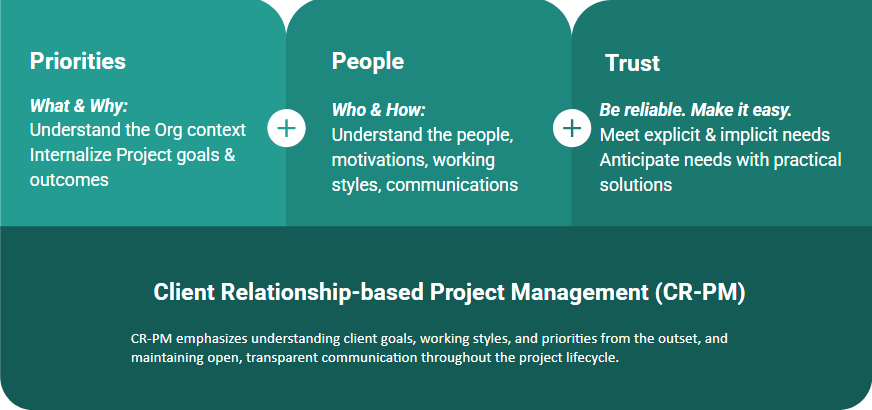
We call this approach Client Relationship–Based Project Management (CR-PM): a way of managing projects that combines disciplined execution with intentional relationship management so work is delivered efficiently and in a way that builds alignment, trust, and reliability with clients.
In client-based work, success depends on deeply understanding both priorities and people — and using that understanding to guide communication, decision-making, and execution throughout the project.
While many organizations track tasks and milestones, CR‑PM goes further: it emphasizes understanding client goals, aligning with client working styles for project engagement, and being a reliable problem solver.
CR‑PM emphasizes:
Understanding the client’s goals and priorities — not just what they want, but why it matters and how it fits into their broader organizational objectives.
Knowing the client as a person and collaborator — including working style, motivations, communication preferences, and how they want to be engaged throughout the project.
Building trust through reliability and problem-solving — anticipating needs, consistently delivering on commitments, meeting explicit and implicit expectations, and doing the heavy lifting to make the project easy for the client.
Experience and research alike show that projects succeed when expectations are aligned and communication is clear and proactive — principles at the heart of CR-PM.
Starting Strong: Discovery
Every successful client partnership begins before the first deliverable is due. During a Discovery phase, we take the time to learn about our client’s organization, project goals, and the people who make decisions and support the work.
We focus on:
Reviewing proposals, RFPs, and project materials to understand objectives, deliverables, and timelines — and to identify what the client values most.
Researching the organization’s history, mission, and milestones to understand the context and culture.
Learning about the roles and backgrounds of stakeholders to anticipate who influences decisions and how.
This preparation ensures that we enter the client relationship with credibility, curiosity, and confidence, which builds trust from the very first interaction.
The Client Huddle: Aligning Goals and Building Trust
The Client Huddle is our structured kickoff conversation. It’s where we learn our client’s “why,” uncover unspoken goals, and set clear measures of success.
During this phase, we align on project goals and success metrics as well as confirm deliverables, scope, and timelines - as every good project management does. Beyond standard project kickoff activities, we also:
Discuss motivations, fears, ambitions, and potential barriers
Identify working styles and communication preferences
Establish clear communication norms for updates and decision-making
Knowing when to engage clients — and when to execute independently — is critical. Some moments call for brainstorming and collaboration; others require us to propose solutions or do the heavy lifting without burdening the client.
For example, if a client prefers hands-on collaboration, we might host short co-working sessions instead of sending lengthy documents for review. CR-PM ensures these decisions are informed by a deep understanding of the client’s priorities and working style, maintaining momentum while honoring how they work best.
Why Relationship-Based Project Management Matters
Client Relationship–Based Project Management is about more than delivering results — it’s about building trust, reliability, and ease for the client.
At Sustainable Schooling, CR-PM isn’t optional or extra; it’s how we deliver excellence. By building relationships directly into the project plan, we don’t just complete projects- we create partnerships that make the work better, smoother, and more impactful for everyone involved.
