
What Families Value Most When Deciding to Stay Enrolled
And What Schools Often Miss About Enrollment Continuity
When schools talk about retention or enrollment continuity, the conversation often starts too late.
Instead of being part of a year-round strategy, it shows up as a spring campaign, a checklist of tasks, or a scramble to “get families to return.”
But families rarely decide to stay based on one message, form, or reminder. They decide based on their overall experience with the school community over time.
Across enrollment research and conversations with families, the same priorities consistently shape whether families choose a school and whether they stay year after year.
What Families Care About Most
Great teachers and strong academics
Families want strong instruction, academic growth, and preparation for what comes next, including college or careers.Safe and inclusive environments
Students need to feel physically safe, emotionally supported, and that they belong.Programs beyond the school day
Athletics, extracurriculars, enrichment, and before- and after-school programs matter, especially for working families.Location and day-to-day convenience
Transportation, commute time, schedules, and logistics shape whether a school fits into a family’s life.
Schools that retain students year after year consistently deliver on these priorities and communicate them clearly over time.
The challenge is not understanding what families value. The challenge is turning those priorities into consistent systems and experiences.
Most schools are doing parts of this work already. The problem is alignment. Retention touches instruction, culture, operations, communication, and enrollment systems, but those efforts rarely operate as a single strategy.

Retention Requires Two Lenses
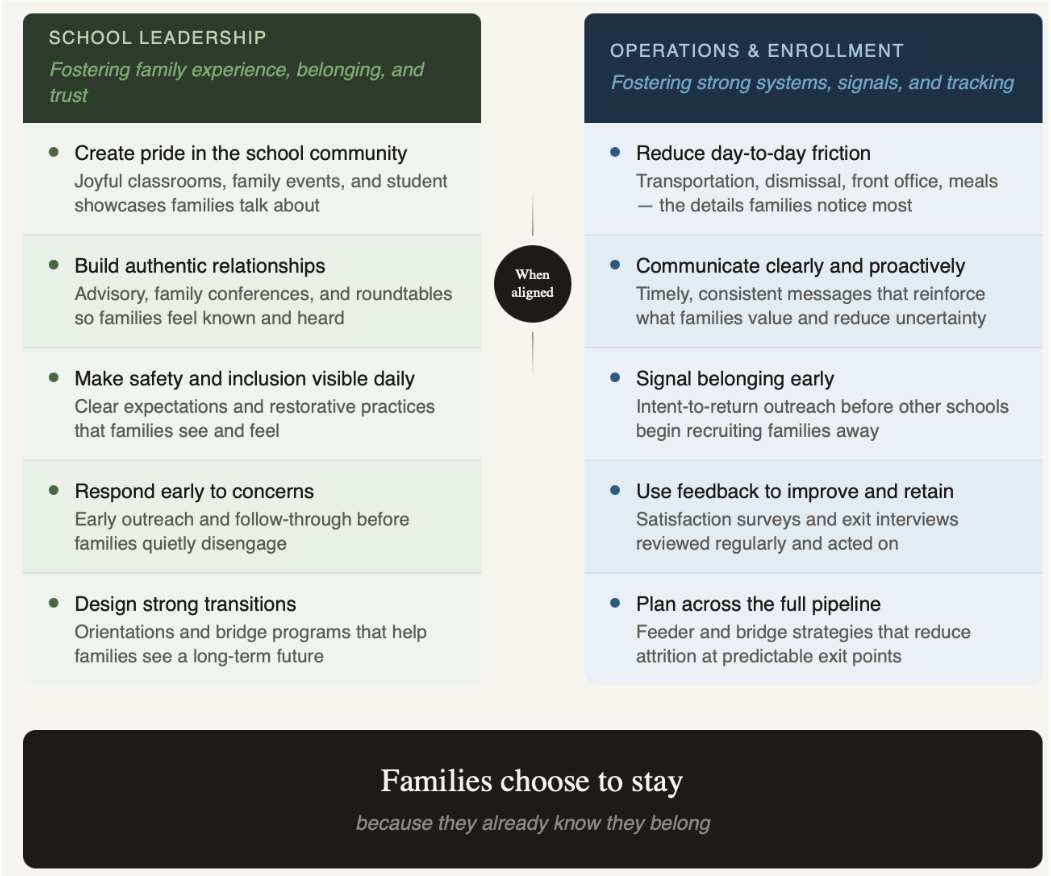
In strong schools, persistence is not owned by one team. It happens through the alignment of student experience and operational systems.
School Leadership: Experience, Belonging, and Trust
Principals and leadership teams drive persistence through the student and family experience:
Creating a school community families feel proud to belong to
Building authentic relationships with students and families
Making safety, belonging, and inclusion visible every day
Responding quickly when concerns arise
Designing strong onboarding and transition experiences between grades
These elements shape how families feel about a school over time.
Transitions are a good example. One network we supported saw steady attrition between elementary and middle school even though families reported high satisfaction. The issue was not academics. Families felt uncertain about what middle school would look like. After introducing student shadow days, family panels with current parents, and spring bridge events, re-enrollment between those grades improved noticeably the following year.
When students feel known and supported and families feel connected to the community, they are far more likely to stay.
Operations and Enrollment: Systems, Signals, and Consistency
Operational systems play an equally important role.
Families experience a school through its day-to-day systems:
Arrival and dismissal routines
Transportation and scheduling
Front office interactions
Communication from the school
After-school opportunities and supports
When these systems run smoothly, families experience the school as organized, responsive, and welcoming.
When they do not, frustration builds.
In exit conversations across several schools, families often point to small operational frustrations: confusing dismissal procedures, delayed responses to questions, or schedule changes communicated too late. Individually these issues seem minor, but together they create friction that makes families more open to exploring other options.
Signals Matter More Than Schools Realize
Families are constantly interpreting signals about whether they belong at a school and whether their child has a clear future there.
One of the simplest but most effective practices schools use is a clear and early intent-to-return process. Schools that reach out early to confirm plans send a powerful message: your child belongs here next year.
Schools that wait until spring often lose families to uncertainty or competing outreach from other schools.
Communication matters as well. Families need consistent reminders of what the school offers, how students are growing, and what opportunities lie ahead.
These signals reinforce confidence and strengthen commitment.
The Bottom Line
Schools rarely lose students because of one major failure.
More often, families leave when small signals accumulate: daily friction, unclear transitions, unanswered questions, or uncertainty about what comes next.
Retention is not persuasion.
It is the visible outcome of aligned leadership, strong culture, and daily experiences that reflect what families value most.
When those elements work together, families do not need to be convinced to stay. They already know they belong.
